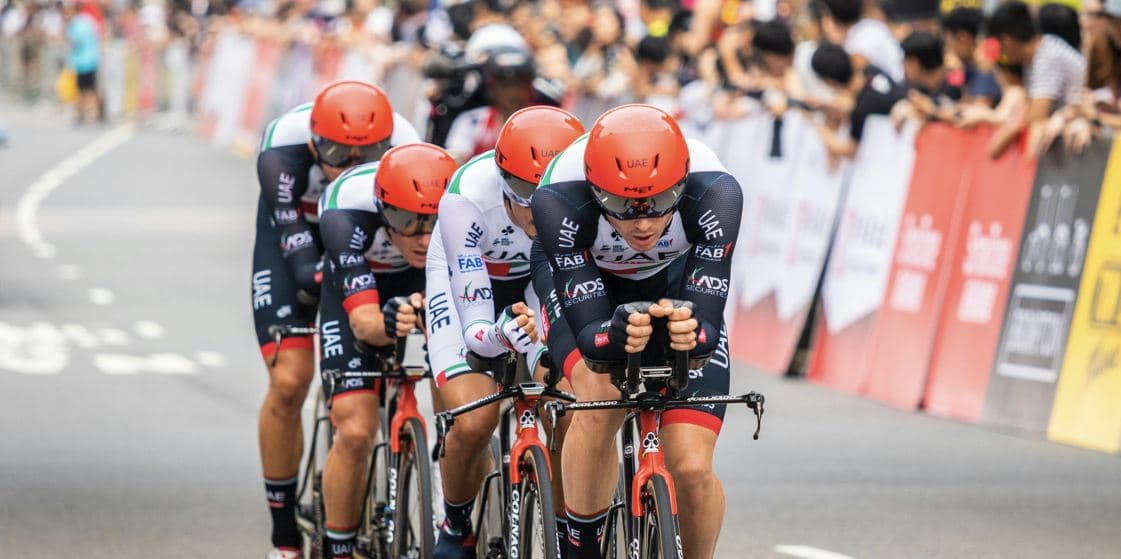
If you’ve joined a group ride, chances are you’ve heard someone mention the paceline. It’s one of the most efficient ways for a group to ride together, helping everyone conserve energy while maintaining a steady pace. Done well, it looks smooth and effortless. Done badly, it becomes messy, inefficient, and potentially dangerous.
For newer riders, pacelines can seem intimidating, but the fundamentals are straightforward once you understand the rhythm.
What is a paceline?
A paceline is a rotating formation where riders share the workload at the front while others draft behind to save energy.
Instead of one rider doing all the work into the wind, the effort is distributed across the group. Each rider takes a short turn at the front, then rotates back into the line to recover.
The goal is efficiency, consistency, and predictability.
There are two common types:
- Single paceline
- Double paceline
Each serves a slightly different purpose.
Single paceline explained
A single paceline is exactly what it sounds like: one line of riders, each following directly behind the rider in front.
The lead rider takes a turn at the front, then moves aside and drifts toward the back while the next rider takes over.
The process repeats continuously.
This format is common in:
- Smaller group rides
- Faster training rides
- Narrow roads
- Situations where traffic requires a compact formation
How it works
The rhythm is simple:
- Ride steadily at the front for a short pull
- Check that it’s safe to move over
- Ease slightly and peel off to one side
- Let the line pass
- Rejoin smoothly at the back
The key word is slightly.
A common mistake is dramatically slowing down when peeling off, which creates gaps and confusion. Another is accelerating when reaching the front, forcing everyone behind to surge.
The pace should remain consistent throughout the rotation.
Tips for riding a single paceline
Hold your line
Ride predictably. Sudden movements create instability.
Keep your pull short
Long heroic efforts are unnecessary and usually unhelpful.
Don’t surge at the front
Just because the wind hits you doesn’t mean the speed should increase.
Rejoin smoothly
Merge gently into the back without sharp movements.
Skip your turn if needed
If you’re fatigued or inexperienced, it’s perfectly acceptable to sit in.
Double paceline explained
A double paceline uses two parallel lines of riders instead of one.
One line typically moves slightly faster than the other, creating a smooth rotating flow where riders cycle through the front and drift back on the slower side before returning to the working line.
This is common in:
- Larger group rides
- Social bunches
- Club rides
- Longer steady efforts
A well-executed double paceline can feel incredibly smooth and efficient.
How it works
Think of it as a conveyor belt.
The faster line moves toward the front.
The slower line drifts backward.
When a rider reaches the front of the working line, they transition across and begin moving back with the recovery line.
When they reach the rear, they merge back into the advancing line.
The movement should be steady, calm, and controlled.
Single vs double paceline
Single paceline advantages
- Simpler to understand
- Easier on narrow roads
- Better in heavier traffic
- Works well with smaller groups
- Less coordination required
Single paceline challenges
- Can be more physically demanding
- Less social interaction
- Gaps become obvious quickly
Double paceline advantages
- Smoother effort distribution
- More efficient for larger groups
- Better conversational/social format
- Reduced pressure on individual riders
Double paceline challenges
- Requires stronger group coordination
- Less suitable on narrow roads
- Can become messy if riders don’t maintain pace discipline
Common paceline mistakes
Surging at the front
This is one of the most common errors.
A rider reaches the front, feels the extra wind resistance, and instinctively pushes harder.
The result:
- gaps open
- riders behind must chase
- the paceline becomes inefficient
Your job is to maintain the existing pace, not increase it.
Braking unnecessarily
Sharp braking creates accordion effects through the line.
If you need to adjust speed, ease off pedalling first before touching the brakes.
Taking pulls that are too long
Pacelines work because effort is shared.
A short, smooth contribution is far better than a long effort that leaves you exhausted.
Overlapping wheels
Never let your front wheel drift alongside the rear wheel ahead.
If the rider moves unexpectedly, contact is likely.
Moving unpredictably
Any sideways movement should be deliberate and smooth.
Sudden swerves are one of the fastest ways to cause crashes.
When not to ride in a paceline
Pacelines are not always appropriate.
Avoid close rotations when:
- roads are wet or slippery
- traffic conditions are unpredictable
- visibility is poor
- the group includes inexperienced riders who are struggling
- roads are rough or full of hazards
Safety always overrides efficiency.
Paceline etiquette for new riders
If you’re new, communicate that clearly.
Most experienced groups would rather know than have someone guessing their way through a rotation.
A few simple rules:
- observe before participating
- ask how the group rotates
- stay calm and predictable
- skip turns until comfortable
- don’t try to impress anyone
No one remembers the rider who skipped a pull.
Everyone remembers the rider who caused chaos.
Final thoughts
Pacelines are one of the most rewarding parts of group riding.
Once the rhythm clicks, they feel smooth, efficient, and surprisingly enjoyable.
Start by understanding the structure, focus on consistency rather than speed, and remember that predictability is what makes the whole system work.